“Populus tremula, Tweedsmuir”

Last week, I took a couple of aspen cuttings to Dundee Botanical Gardens. They will spend a year or two in the nursery of the Native Plant Communities Unit (see http://www.dundee.ac.uk/botanic/garden/collections/)

Their new labels announced them: Populus tremula Tweedsmuir.

They will add genetic diversity to the collection, and are two of the eight I produced after collecting roots on the A701 (see  https://inthepresenttense.net/2011/03/15/plantcollecting-on-the-a701/)

Specimen 19760128DA in the Native Garden also has expansion plans. I map out lines of runners and ramets radiating from his/her diamond marked trunk:

The ramets confusingly do not necessarily have aspen-shaped leaves. At their tops, closest to the light, the leaves are largest and pointed with round stems – no quaking here.

Indeed, a determined advance by 19760128DA, who is using the right to roam.

reaching Durban by air is simple

Swallows were here early this year – beginning of April. They sit on wires, preening, having made the flight over. Swooping for insects, refurbishing last year’s nesting sites.

Swallows are South Africa’s Bird of the Year this year. In November, there will be a welcome party for them near Durban: three million use reedbeds at Mount Moreland to roost after their migratory flight from Europe. The sight of millions of swallows landing at dusk is celebrated by local people who regard it as a breathtaking natural spectacle. Later on in November, United Nations delegates will be welcomed at the new King Shaka Airport for the International Conference on Climate Change.

Observing this coincidence, I am delighted to be able to distribute a special set of eight airmail stickers. The series stems from a South African design.

Airport expansion at Durban recently brought Boeing 747s and Airbusses into shared airspace with the barn swallows, who arrive from Europe to roost in Mount Moreland reedbeds on the wetland of Lake Victoria – less than two kilometres south of the new King Shaka airport. This attracted the attention of Birdlife International, concerned about the impact of the new airport. A compromise averted the drastic measure of eradicating the reedbeds, which had been suggested. Radar imagery warns airport controllers of twilight bird movements that might endanger aircraft and passengers by ‘birdstrike’.

The new runways at King Shaka Airport are big enough to allow Airbus and Boeing 747s to land and turn. This development is part of a planned Dube Trade Port, which rests on the vision of an aerotropolis, a city with an airport at it centre to assist the flow of cargo and capital.

This infrastructure will serve international politicians and delegates travelling for the Climate Change talks. As the United Nations conference website explains, getting to Durban couldn’t be easier:

“On the 1st May 2010, the new Durban International Airport situated in the north, at La Mercy swung into operation World Cup visitors were the first to glimpse Durban from a spacious, air conditioned complex with separate Arrival and Departure terminals. A range of relaxation areas, shops, restaurants and entertainment options keep passengers occupied while waiting for flights. Convenient hotels and conference centres also form part of the development which is minutes from the beaches and resorts of Durban’s North Coast. The new King Shaka International Airport (KSIA) provides international access to Durban and accommodates the largest aircraft in the world. With direct international flights by Emirates Air and other airlines expected to follow suit shortly, reaching Durban by air is simple.”

http://www.cop17durban.com/Durban_Information/Transport/Pages/Getting_Here.aspx

 Notes

This develops previous work on ‘Swallow’ where I took a zoological specimen of Hirundo rustica as a point of departure. I flew with it to South Africa in 2007 –  permission was granted from customs on the basis that the dead swallow was ‘stable at ambient temperatures’  so I could take it to a residency at Stellenbosch University Visual Arts Department.  New work will be shown at the 4th Biennial Australian Animal Studies Group Conference in Queensland Australia (my submission will be sent by airmail). You can follow artistic developments on this blog. I will post research on http://meansealevel.wordpress.com. For previous work on ‘swallow’, go to http://www.meansealevel.net/?q=node/22

Welcome to free airmail stickers – just contact me.

tree-lines / aspen


summary of project at Over Phawhope Bothy, Ettrick Valley, Southern Upland Way

… the right to enter on to, roam on and pass over open country …

Aspens grew on me, as a wild presence exercising their right to roam. Aspen trees are fragments of the wildwood that extended across Scotland after the ice age. Thinly scattered, you may find a few remaining aspen stands in the southern uplands – in cleuchs beyond the reach of sheep’s teeth, or possibly surrounded by spruce plantation in dispirited clumps. Present in larger numbers, they can support a varied ecology. In leaf, aspens can be recognised by the way their thin-stemmed leaves shimmer and turn yellow in autumn.

I learnt to recognise aspens in winter habit, locating the nearest ones to Over Phawhope Bothy.  I was taught to propagate them by encouraging them to form suckers  – in the wild they spread themselves as clones, commandeering what space they can.  A stand of aspen is likely to be very ancient, yet comprised of young trees that defeat death by sending runners.

… the separation of individual ramets, or daughter plants, occurs by the death of intervening connections, known as stolons or runners…

Near Over Phawhope Bothy, you can find two new young saplings that I planted and will keep an eye on until they are established.  In time, their movement and colour can enliven the line of conifers that cast a dark tone behind them. Perhaps with more time, aspen may provide avenues of growth within a changing climate.

The photo above is of aspen in a protected cleuch in Moffatdale – some of the closest wild trees to Over Phawhope Bothy  (taken in March 2011).

plant-collecting on the A701

I travel many miles looking for aspen. No Populus tremula at Dawyck Botanic Gardens (a kind of Tree Zoo). Down the A701: a grove by the side of the road.

I have permission to take a root cutting, but no-one to tell me which tree. Check the ID book: yes, it has diamond marks on its bark.

and sharp-ended leaf buds on brown stems:

Ok, dig. Looking for thick roots – just find strings. Wrongly assume need to dig deeper. My spade too big and too blunt. Lots of stones. A personable man and his son stop in a big green 4×4 to check I am not burying a body. Eventually work out that the roots get thicker and nearer the surface as you get away from the main stem. Find a wee sucker and that is where I find a finger-sized root. Use hands to pull it out together with a big pair of choppers, glad I brought them along.

Aspen grow on me, a wild presence, self-cloning their way along the burn.

I read later why I had to move away from the tree to find a runner – aspens defeat death with death:

Each of the morphological structures known as rhizome, stolon, runner [&c] undergo vegetative multiplication by death and decay of old tissue … Death of the stolon or runner separates these rooted and now independent daughter plants, each of which is termed a ramet.  The ramets produced from one parent collectively form a genet or clone. (Plant Form, written by A Bell, drawn by A Bryan, p 206.)

Aspens quietly suckering their way as they can, commandeering space in the few corners they have left.

Fragments of this genet now sectioned, sandwiched with No 3 John Innes, set at 18 degrees C in a propagator.

Rhizomatic action seems to assume a rather purposeful and linear form, when biotic survival is concerned.

This particular aspen grove cannot be sure of its survival, I am told by its manager – too close to a planned access road for wind turbines.  So now, what are now more numerous, wind turbines or aspens? I am also told that a wind turbine has vast concrete roots.  I’d like to chip away at that too, and propagate a tiddler, on a community scale.

a potted history of forests in the Scottish Borders

After the last Ice Age, 10 000 years ago, gradually forest established itself in Southern Scotland, mainly dominated by oak. The  map above shows how much of that has been lost in the last six thousand years.


To quote from The Carrifran Wildwood Story (p17)

A few ecologists argue that complex natural factors – rather than human activities – are mainly responsible for forest loss in the Highlands and Wester Isles, but everyone agrees that hmans and their associated grazing animals have played the major role in the Southern Uplands. In this area, pastoralism became significant thousands of years ago and forest clearance accelarated in the [early Middle Ages], but the beginning of the end for the natural woodlands of the Scottish Borderlands came with the monastic exapnsion of the 12th century. the large and well documented flocks of sheep and herds of cattle, as well as the rarely mentioned goats, gradually inhibited the natural regeneration of trees and led to the development of increasingly senile woodlands.

In the following centuries, warfare often involved scorched earth policies and the felling of many trees, but as pointed out by Chris Badenoch …. the lawlessness of families and internceine strife may have had equaly serious impact on forests, and any attempt at enclosure and regeneration or replanting was doomed by action of one’s neighborus. There were efforts to conserve woods, but the are in the western Borders known as Ettrick Forest seems to have been largely denuded byt the 16th century. Reently it was estimated that in the Borders as a whole, only around 0.25% of the land carried semi-natural woodland.

The current situation is that most of the native woodlands have vanished, replaced by ‘sheepscapes’ – artificially maintained grassland – and commercial forestry, mainly monoculture of conifers.

Some references:

Source of map: The Carrifran Wildwood Story, by Philip and Myrtle Ashmole, Borders Forest Trust, 2009 (p16)Richard Tipping: (1997) Vegetational history of southern Scotland, Botanical Journal of Scotland49 (2), 151-162

TC Smout (Editor) People and Woods in Scotland,  a history. Edinburgh University Press.

http://www.carrifran.org.uk

http://www.bordersforesttrust.org

http://www.treesforlife.org.uk

http://www.forestry.gov.uk/scotland

euroforest: Run, animals! Run!

In the uplands of the Scottish Borders, it’s mainly farming for sheep and trees – and now wind too. euroforest styles much of the landscape. (Not any company in particular  – I use a small ‘e’ generically.)


I do not know who owns the patch next to where we live – but last Monday night ‘they’ started felling euroforest by floodlight. This week a cut is extending into a familiar view.


Last year we received a letter to reassure us that the contractors would be careful when they logged the section around our water supply. This year new work took us by surprise: Now the holes in the road out of the valley will now really go to pot! Hope the drivers look out for children, dogs, chickens.

So little I know. Who pays for the holes the lorries make? How much is a spruce worth? What is the wood good for?

I wanted to film the machine at work but it’s hard to actually speak to the operator to get permission. We wave at each other. I draw. I know nothing about these vehicles. I see them in animal terms: limbs, joints, mouths, and lots of erections. I think maybe the endbit  is called a grapple-hook. It is very dextrous.

A saw appears like a tongue after it grabs the trunk. It takes less than a minute to strip a tree and chop it.  Last year I tried to hide from these scenes. This year I decided to learn about what happens. Seeing a tree fall is exciting. (I have read that artists in the Arctic cheered as huge blocks of ice fell from the bergs they watched, talking about climate change.)

Last year two girls ran along the leat which was to be cleared, shouting: “Run animals! Run!” What animals are there to run? Despite the dead space between closely packed spruce trees, we have seen squirrels, hare, foxes, deer, badgers, and crossbills (were they nesting yet?). Buzzards, pigeons, siskins, what do they do?

Maybe the brush offers shelter, voles kept in view by a hovering kestrel. ‘Snags’ –  dead standing trees – give vantage points for buzzards, crows.

One section of euroforest has been de-stumped. This seems crazy: it is rumoured to go to Lockerbie Biomass power plant. Renewable? However much oil does it take to dig stumps up and transport them? Elsewhere, ‘residues’ are scraped up. I wonder about dead wood decay into soil,  about invertebrates? I am told dead wood adds methane to the atmosphere, acidifies the soil. What do I know? We see the soil run off in heavy rain.

euroforest is busy also in the Ettrick valley. On Monday residents’ anger will be aired at a public meeting. Broken promises, potholes, scarring access roads, abandoned sheep farms.

Erasure of place upsets. We use words like ‘blanket’, ‘swathe’, ‘obliteration’, ‘monoculture’. There are traces of sheepscapes.

With occasional trees older than a single human generation.

My proposal is to plant an aspen at upper Phawhope bothy at the head of Ettrick valley – as a Way installation inspired by the Forest Bookstore in Selkirk.

Endnote: This photo-essay is an introduction to my project ‘in the present tense‘ – fieldwork as an environmental artist about land use in the Scottish Borders.  I look for entwined patterns of co-existence as animals, people, climate and land adjust to each other.  I use drawing as a tool for investigation and this brings me into contact with people whose livelihood depends on the land. This highlights the resources of knowledge, skill and design underlying what may be seen as pastoral Borders’ scenery. This takes place within an industrial scenario where commodities are extracted. I think of my task as being to look carefully, scrutinise my own preconceptions and lack of knowledge, and draw out new connections. Borders’ farmland has been described as “sheep and trees, cows and ploughs”.  I began with sheepscapes and am now moving onto trees. Tree-lines as a project started with the idea of deadwood and its generative possibilities – trying to ‘think like a tree’, prolong my anthropocentric time-line, and deepen my investigation to take in more about what is under my feet, and above my head.

Tree-lines offer a malleable idea for further investigation … land-use … climatic transition … life-lines  and shelter … diagrammatic rendering (productivity, biomass, carbon sequestration) … pattern and repetition … supply lines … cultural entanglements …
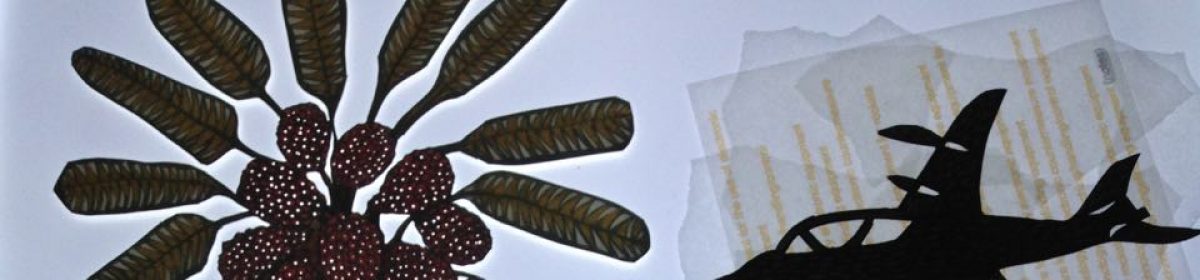
walks at mean sea level

Two walks in changeable places on the south west and south east English coast:

muddy places full of overwintering wading birds

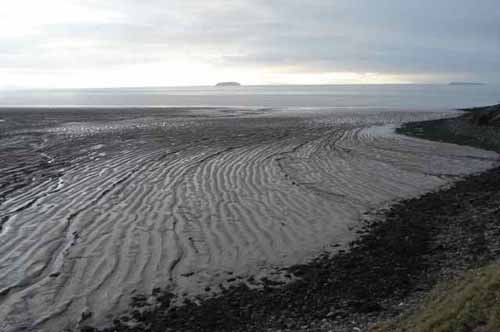
The Severn from Sand Point – overlooking the lowest point for a possible Barrage (plans now shelved)

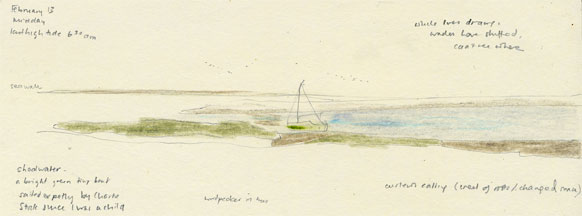
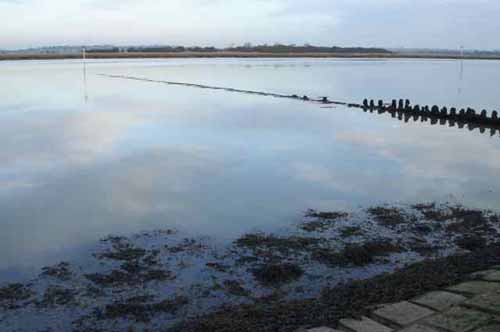
Ray Island on the Blackwater Estuary in Essex, a stone throw from proposed nuclear power station (Bradwell 2)

Grazed by a flock of Shetland sheep

Ray Island, uniquely self-forming from mud in a sheltered creek

a line of shrubs just visible above the sea wall, reddening into spring

thinking like a tree: significant humans?

Aldo Leopold offers us a mountain’s view in Thinking like a mountain:

Only the mountain has lived long enough to listen objectively to the howl of a wolf … I now suspect that just as a deer herd lives in mortal fear of its wolves, so does a mountain live in mortal fear of its deer. And perhaps with better cause, for while a buck pulled down by wolves can be replaced in two or three years, a range pulled down by too many deer may fail of replacement in as many decades. So also with cows. The cowman who cleans his range of wolves does not realize that he is taking over the wolf’s job of trimming the herd to fit the range. He has not learned to think like a mountain. Hence we have dustbowls, and rivers washing the future into the sea. (full text on http://www.eco-action.org/dt/thinking.html)

I decided to start by trying out thinking like a tree (some images on inthepresenttense.net) and to make hand puppets, following discovery of Paul Klee’s puppets made for his son, and also the inspiring work of Noa Abend. The first question: who are the significant humans for a tree?

In Phawhope, at the head of Ettrick Valley, significant humans include Fountains Forestry. The website indicates a multinational company, with interests in Europe, US, and Latin America. They broker sale of the rainforest, offer the opportunity for carbon sequestration … and offer a leaflet on woodland management, bristling with plastic tubes. No images of personnel.

Meanwhile the last week has seen an opposition day debate in Parliament calling for a rethink of the plans to sell forests – for example by 38 degrees:

Every single MP heard from hundreds of us this week. But a lot of them will be hoping the fuss will now die down. We need to get back in touch quickly, to prove we are here for the long haul. MPs need to feel we’ll keep watching them until our woods are protected for future generations.

It appears that my MP thought differently, casting a neo-liberal vote in favour of the Government’s plans for  a ‘new approach to ownership and amangement of woodlands and forests’, shifting the balance from Big Government to Big Society.

Thinking bigger – from individual tree to forest – it seems that Ettrick Valley head is to be substantially replanted – an erasure of sheepscapes with another commodity production. Will it become a suitable site to reintroduce wolves? Might wolves restore it to a valley of colours, as Phawhope reportedly means?

Jim Crumley has described the wolf as ‘painter of mountains’, because the reintroduction of wolves to a heavily denuded landscape causes a gradual shift in colour across the lanscape, starting with the recovery of grasses, mosses and young trees, then the return of wildflowers, and so on.


thinking like a tree

In “Thinking like a  mountain”, Aldo Leopold wrote: Only the mountain has lived long enough to listen objectively to the howl of a wolf. I start by trying to think like a tree. Paper pulp, bits of spruce, an old tree guard. In a woodland management leaflet (from Fountains Forestry) a photograph shows lines of plastic tubes beckoning to the future.
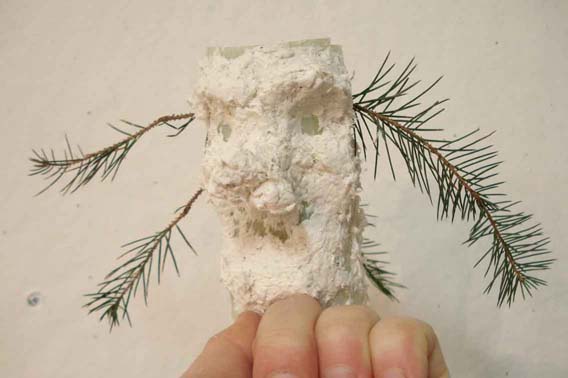

snags, and what they offer

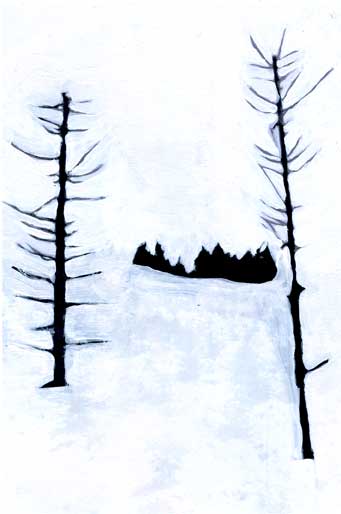
Snags in snow, clear-felled forest: a photograph painted over to allow a focus on deadwood, and its generative possibilities.

In Glasgow, Tacita Dean exhibits her version of painted over photos (only the trees retain their form – perhaps the point is within the gelatin surface). Camouflage manuals, Disruptive Pattern Materials, where figure and ground merge.
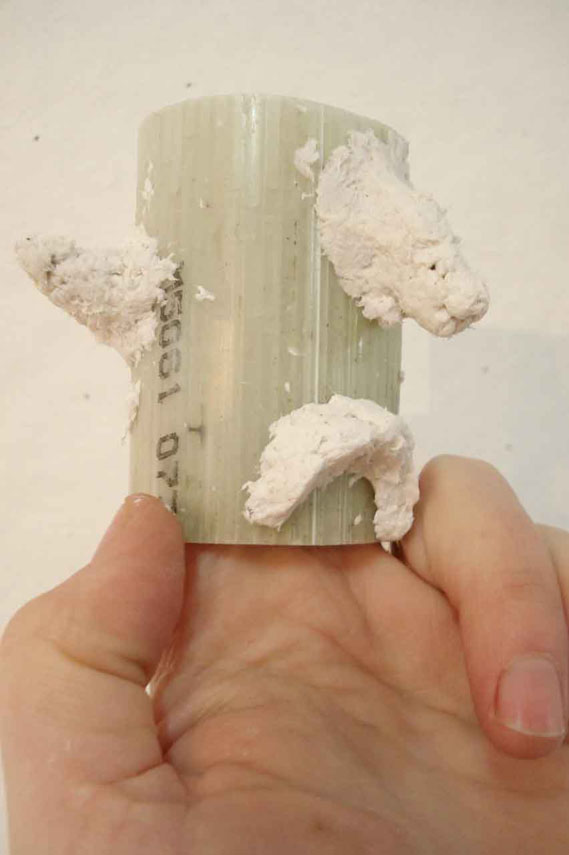
A conversation with an entomologist: forest ecology is complex, how much do you want to know? Insects are involved at each and every stage, as living wood turns into soil. The way invertebrates and fungi move in differs whether the wood is standing or on the ground.
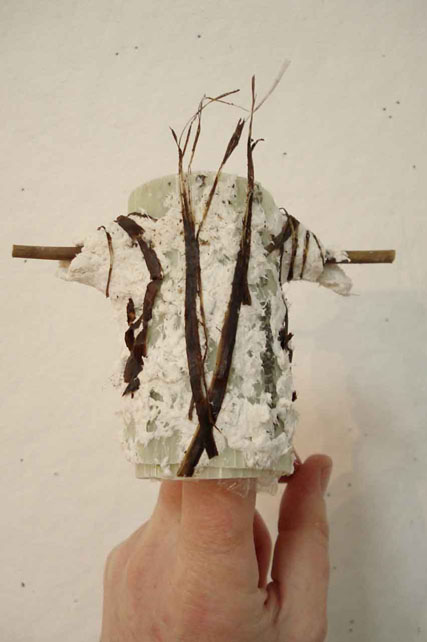
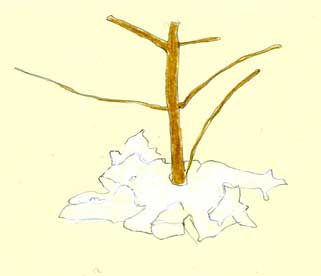
Papier mache: chewed paper, or mashed, with oil of cloves as an insect deterrent. A modelling material, in which I implant a small, spruce, snag.

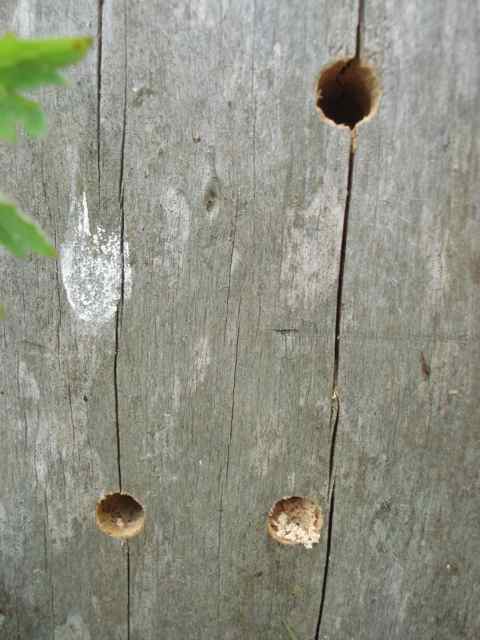
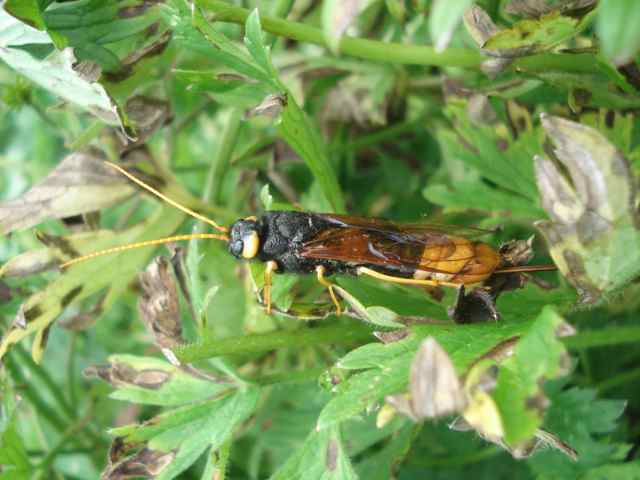
From last summer, photographs of an emerging woodwasp. A sawfly, who can wait till the  moment is right. Who prefers live or green spruce.